
Insulating glazing, essential for the thermal and acoustic performance of a building, is subject to strict quality criteria, regulated by the standard SR EN 1279:2018. This standard defines the parameters that must be respected to ensure the acceptability of the appearance of the windows and to guarantee a quality product.
Appearance defects of the glazing
A window may be considered visually defective if there is asymmetry in the view of the outside environment through the window, which may disturb an observer.
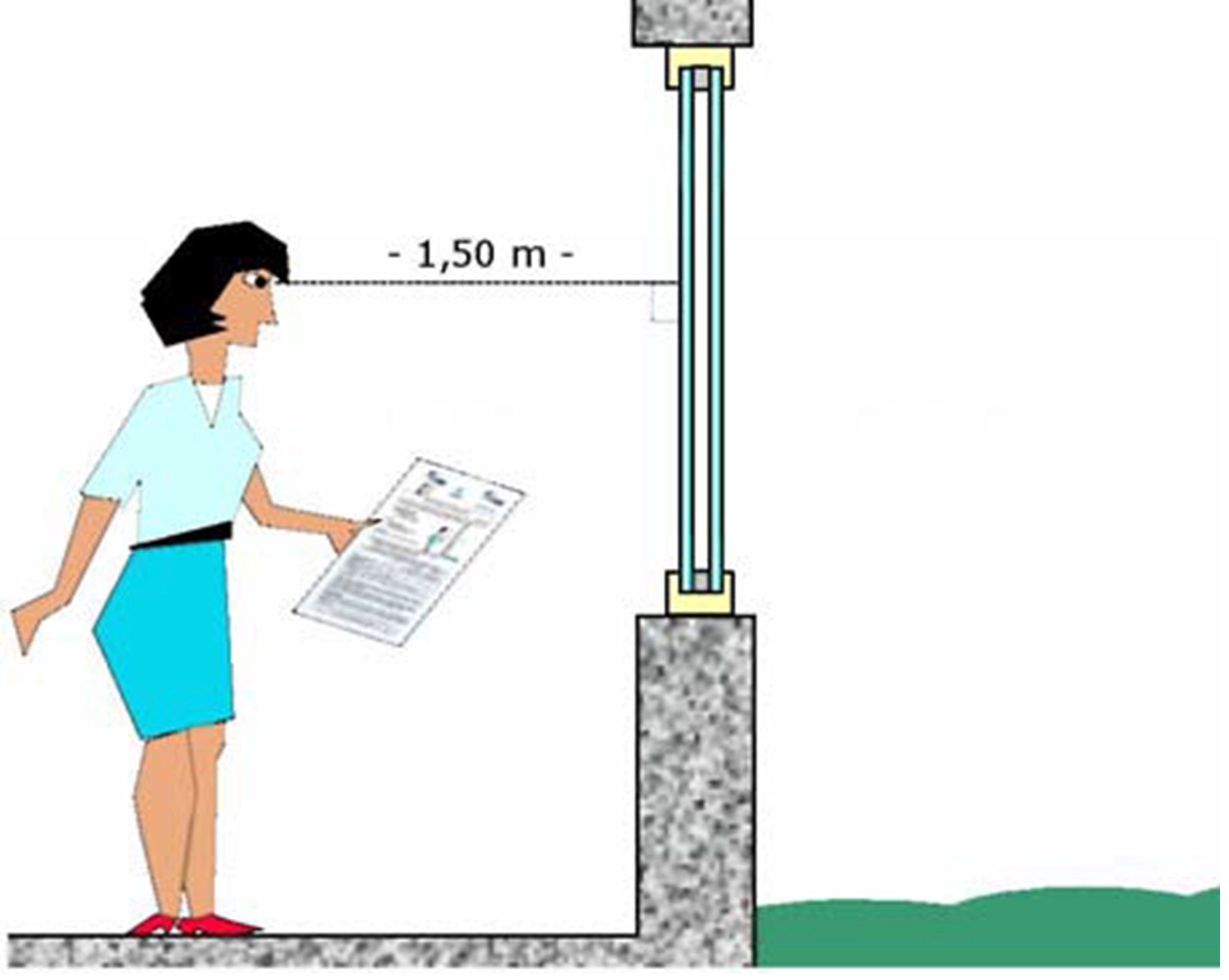 Examination conditions:
- The observatory must be located in a room, at a distance of 2 meters from the window.
- The gaze must be perpendicular to the window, outwards, and last 30 seconds for each window.
- The examination is done in conditions of uniform lighting, without direct sunlight.
Brightness:
- In the absence of sunlight falling directly on the window.
It is considered defective, depending on the examination conditions:
- Point asymmetry (bubble type) exceeding 1 mm;
- Linear asymmetry (scratch type) exceeding 8 mm.
Criteria for acceptance of defects in insulating windows

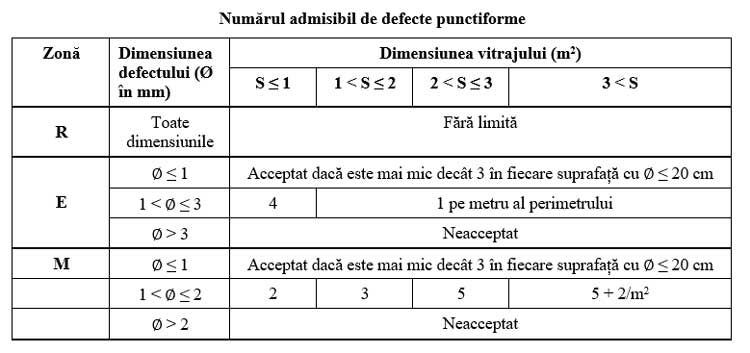
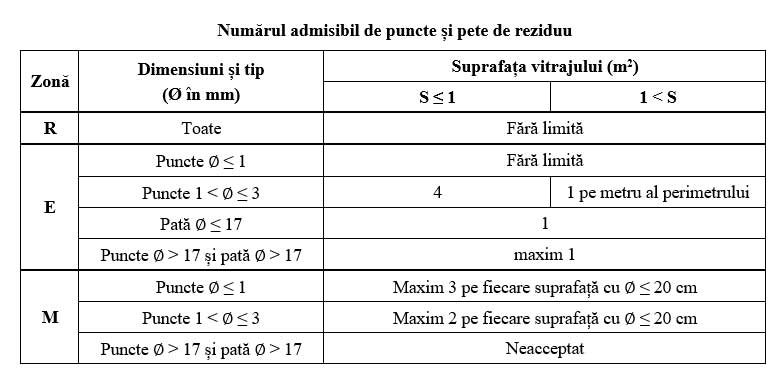
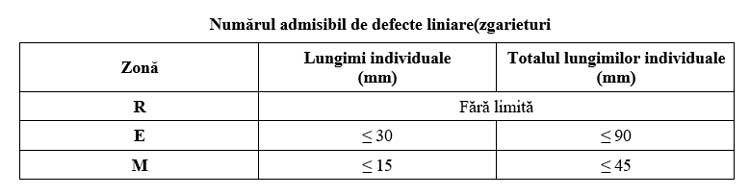
tables taken from the SR EN 1279:2018 standard
The parallelism of the lines
The deviation of parallelism between the bars of the slats and between the bars of the slats and the edge of the glass must be:
- ≤ 2.0 mm/m in the case of elements with a continuous length ≥ 50 cm;
- ≤ 1.0 mm/m in the case of elements with a continuous length < 50 cm.
The parallelism between the slats and the edge of the window
A deviation of parallelism between the bars of the slats and the edge of the window is allowed:
- ≤ 2.0 mm/m in the case of elements with a continuous length ≥ 50 cm;
- ≤ 1.0 mm/m in the case of elements with a continuous length < 50 cm.
Splicing
The joints or glued elements of the slats may show a certain discontinuity at the joint. This discontinuity, which corresponds to a technical manufacturing tension, does not constitute a defect.
Small gaps may appear in the lake level near the cut lines; they are inherent in the manufacturing process and do not constitute a defect.
Soft contact - glass
In the case of large insulating glazing, contacts can occur between the slats and the glass sheets, contacts that leave marks on the glass products and that sometimes generate noise when handling the sashes. This is not a manufacturing defect.
Scratches on the surface and point defects of the slats
Scratches and point defects visible under normal observation conditions constitute significant manufacturing defects.
If at least one of the criteria below is exceeded, the frosted glass is not acceptable:
Surface scratches on the slats
- a scratch with a length of 5 mm or a width greater than 1 mm;
- 5 scratches on less than 1.50 linear m of profile;
- the scratch whose color is identical to that of the profile and with a length ≥ 20 mm;
- the scratch whose color is different from that of the profile and with a length ≥ 5 mm.
Point defects on the slats
- minimum size considered: 1 mm
- maximum size allowed: 2 mm;
- enough 5 points on less than 10 linear cm of profile;
- enough 10 points on less than 50 linear cm of profile.
Cracking of the surface of the screeds
Microcracks imperceptible under normal observation conditions, but visible in oblique light and/or close-up, can be seen on anodized or thermo-lacquered aluminum surfaces. These do not constitute a defect.
The marking of insulating glazing
The marking, where it exists, is an identification element of the glass manufacturing. Most often, it is found on the visible inner face of the spacer profile.
Joining the spacer profile
The presence of several joining points of the spacer profiles does not constitute a defect.
The number of joint points, apart from angle joints, can reach 3 without this constituting a defect.
The space between two elements placed end to end can locally reach 1.5 mm, without this constituting a defect.
The spacer profile must not be visible on the viewing surface.
Restrictions on the use of these criteria
Insulating windows have certain characteristics that depend on the composition of the glass sheets and their structure (composition). Certain phenomena may appear as a result of these characteristics.
Deformation of objects seen through glass
The deformation of the bottles can occur as a result of three causes that act in isolation or cumulatively.
The deformations of thermally treated bottles
The maximum allowed global and local flatness tolerances are defined in the following standards:
SR EN 12150 - for safety glass.
SR EN 1863 – for tempered glass. 56 Top
The variation in the volume of the air cavity or gasz
The cavity formed by inserting the spacer rod between the glass sheets changes its volume depending on the temperatures and the external atmospheric pressure. The glass sheets of the insulating windows react to these volume variations by bending to a greater or lesser extent, inwards or outwards, depending on the rigidity and the climatic conditions. These deformations can be calculated, but can only be avoided in the case of small windows composed of thick glass sheets. Unless there are valid counter-arguments, the outer glass must have a thickness greater than or equal to the inner glass.
The deformations of the bottles caused by the variation of the gas volume in the cavity do not constitute a defect.
The deformation generated by the lack of flatness of the mounting supports
Any mounting system (fixing, mounting...) as well as the flatness of the frame influences the flatness of the glass.
Optical distortions related to these deformation phenomena are unavoidable and do not constitute a defect.
Staining of clear glass and glass with deposition
Ordinary clear glass always shows a slight coloration in the transmission, inherent in the composition of the glass.
The color will be all the more accentuated the thicker the glass. This will influence the shade of the elements incorporated in the insulating glazing and also the uniform character of the shade of the walls made up of elements of different thicknesses, as well as the shade of the elements viewed through the glass.
This coloring of the clear glass does not constitute a defect.
Improving glazing performance requires the use of laminated glazing. These may cause changes in color rendering. This shade variation does not constitute a defect.
Appearance variations
All types of glass, regardless of whether it is clear, colored, with deposition, varnished or ornamented, show slight variations in shade from one production campaign to another. It is possible for a shade difference to appear between a window and the adjacent windows.
This variation does not constitute a defect.
The "flowers" resulting from thermal treatments - anisotropy
In its normal state, glass is an amorphous material, therefore isotropic, i.e. it presents identical optical (refractive index) and mechanical properties in all directions.
The thermal treatment of the glass (secured or tempered) induces in the glass a compression zone at the surface level, as a result of this phenomenon the glass becomes anisotropic.
The natural light and the reflection properties vary from one point to another, the glass showing variously colored motifs that are due to light interference phenomena.
Anisotropy is not a defect.
Interference fringes
In certain transitory lighting conditions, optical phenomena can occur by combining the rays reflected on the glass surface, which can lead to the appearance of colored fringes, called interference fringes (Brewster fringes).
This phenomenon is due to the flatness and perfect parallelism of the glass faces.
The interference fringes move when pressure is applied to the center of the glass. The risk of fringes appearing is reduced in the case of windows with asymmetric composition.
This phenomenon of interference fringes does not constitute a defect of the glass.
The condensate
Condensation on the surface of glass sheets can occur:
- on the outer side of the window from the outside (side #1).
- on the outer face of the glass from the inside (face #4 in the case of double insulating glass).
- on one of the faces from the cavity (face #2 or #3)
Condensation on the front of the glazing from the room
The presence of condensation on the face of the glass from the inside is the result of one of the following situations:
- poorly heated and/or insufficiently ventilated space;
- very humid space due to the degree of occupation of the rooms or the presence of important sources of humidity (kitchen, plants...);
- very low outside temperatures.
In the case of using insulating windows, the frequent phenomenon of condensation generally signals the existence of a poorly heated, insufficiently ventilated or very humid space.
Only the intervention on these parameters is likely to lead to significant improvements.
The appearance of condensation on the face facing the room is not a defect.
Condensation on the face of the glazing from the outside
Surface condensation on face #1 of insulating glass will occur if the temperature of this face of the glass is much lower than the temperature of the outside air and if the dew point (the temperature at which water vapor becomes liquid) of the latter is higher than the temperature of the glass.
The surface temperature on the outside of a window depends on:
- the flow of heat that comes from the inside and crosses the glass. It depends on the existing temperature differences between the inner surface and the outer surface of the glass and on the Ug value of the latter;
- the loss of energy through convection, with the outside air;
- the loss of energy through radiation, especially towards the sky.
Various studies as well as the measurements carried out indicate that heat exchange by radiation is relatively limited in cloudy weather. On the contrary, when the sky is clear at night, there are significant thermal losses to the sky.
Studies have also shown that:
- a simple window never has a surface temperature below the temperature of the outside air, so the formation of condensation on the outside face is excluded;
- the improvement of thermal insulation (low Ug value) implies the reduction of heat transfer to the external surface: the external glazed surface is colder, and the risk of condensation increases;
- when the wind speed is high, the temperature of the glass tends to approach that of the outside air;
- the risk of the glass having a much lower temperature than that of the outside air decreases as the outside air cools.
In conclusion, the superficial condensation on the outside of the windows is a phenomenon that can sometimes be observed at night and in the early hours of the morning on well-insulated windows, when the sky is clear and in the absence of wind. Thermal losses to the clear sky are the main cause of this phenomenon.
The phenomenon of condensation on face #1 is proof of good thermal insulation and does not constitute a defect.
Condensation on one of the faces inside the cavity
When condensation appears between the glass sheets, it is considered defective. The insulating glass must be replaced.